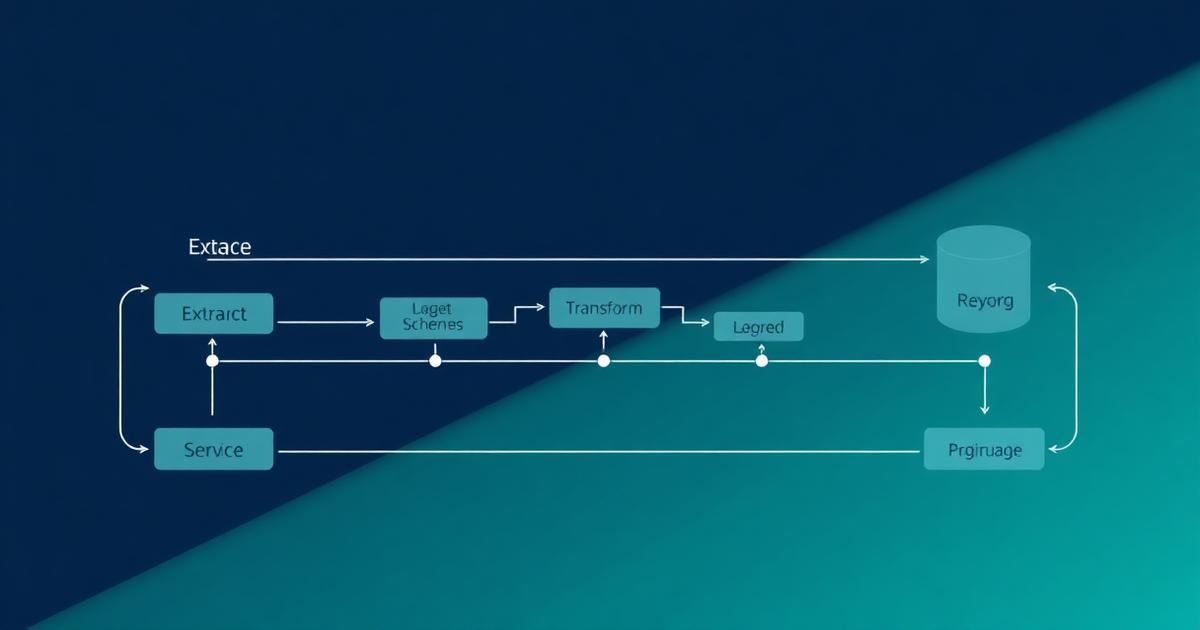
5 ETL Mapping Mistakes That Break Pipelines — And How to Fix Them
The Hidden Cost of Bad Mappings
Every data pipeline has an ETL layer — Extract, Transform, Load. And every ETL layer depends on mappings: the rules that define how data moves from source schemas to target schemas.
When mappings are wrong, everything downstream breaks. Reports show incorrect numbers. ML models train on garbage. Compliance audits fail. And the debugging process? It's brutal, because mapping errors are silent. They don't throw exceptions — they just produce wrong data.
After years of building data integration platforms and working with enterprise data teams, we've identified five mapping mistakes that cause the most damage — and the practices that prevent them.
Mistake #1: Hardcoding Transformations Inside ETL Scripts
The Problem
The most common anti-pattern in data mapping is embedding transformation logic directly in ETL code. A Spark job or SQL script contains inline logic like:
```
CASE WHEN source.status = 'A' THEN 'Active'
WHEN source.status = 'I' THEN 'Inactive'
WHEN source.status = 'P' THEN 'Pending'
END AS target_status
```
This works — until you need to add a new status code. Now you're modifying production ETL scripts, redeploying pipelines, and hoping you found every place that logic exists. Spoiler: you didn't. It's copy-pasted across three other jobs.
The Fix: Externalize Mappings as Governed Assets
Transformation logic should live outside your ETL code, in a governed mapping layer. Define the status transformation once as a reusable rule function. Reference it from every pipeline that needs it. When the rule changes, every pipeline picks up the update automatically.
This is the core principle behind Metadata as Code™ — treating mappings with the same rigor as application code. Version them. Test them. Deploy them through CI/CD.
Mistake #2: Ignoring Schema Evolution
The Problem
Schemas change. Columns get renamed, data types get altered, new fields appear, old ones get deprecated. Most mapping implementations assume schemas are static — and shatter when they're not.
The typical failure mode: a source system adds a new required column. Your ETL job doesn't know about it. The pipeline runs successfully but silently drops the new data. Three weeks later, someone notices the analytics are wrong.
The Fix: Schema-Aware Mapping with Drift Detection
Every mapping should be bound to a specific schema version. When a source or target schema changes, the mapping engine should:
1. Detect the drift — Compare the new schema against the version the mapping was built for.
2. Assess the impact — Identify which mappings are affected and whether they'll break.
3. Notify stakeholders — Alert the data team before the pipeline runs with stale mappings.
4. Block if critical — For breaking changes (dropped columns, type changes), halt the pipeline and require explicit mapping updates.
In Magellan, this is handled by the persistent knowledge graph. Every schema version is a node. Every mapping references specific schema versions. When a new version arrives, impact analysis is a single graph traversal.
Mistake #3: Manual Field Matching at Scale
The Problem
When integrating a new data source, someone has to match source fields to target fields. For 20 fields, this is tedious but manageable. For 200 fields — across nested structures, with inconsistent naming conventions — it's a multi-week project riddled with errors.
The worst part? Most of these matches are obvious to a domain expert but invisible to the person doing the mapping. "subscriber_id" and "member_number" are the same thing in insurance. "dx_code" and "diagnosis_icd10" are equivalent in healthcare. But the mapping analyst who doesn't know the domain maps them incorrectly — or skips them entirely.
The Fix: Semantic Matching with the Magellan Semantic Match Engine
Automated matching that understands meaning, not just string similarity, eliminates the bulk of manual mapping work. The Semantic Match API delivers:
- Integer confidence scores (0–100) so you know which matches to auto-approve and which need human review
- Domain-aware matching — in internal benchmarking, the engine reaches 92% top-1 accuracy on healthcare schemas vs. 87% on a mixed general-purpose corpus[^bench]
- Match classifications (synonym, abbreviation, domain equivalence) so you understand *why* a match was suggested
[^bench]: Benchmark figures from an internal evaluation of Semantic Match Engine v1.0.0 (google/gemini-2.5-flash, temperature 0.1) on a 500-pair test set drawn from FHIR R4 and X12 834/835/837 schemas (healthcare) and a mixed industry corpus (general-purpose). Accuracy is defined as top-1 algorithm-class agreement with steward-validated gold pairs.
The result: 80% reduction in manual mapping time, with fewer errors than fully manual approaches.
Mistake #4: No Lineage Tracking
The Problem
You've built your mappings. The pipeline runs. Data flows from source to target. Then someone asks: "Where does this revenue number come from?"
Without lineage, answering that question means:
1. Opening the ETL script to find the transformation
2. Tracing back to the source query
3. Checking which source table feeds that query
4. Hoping the documentation is current (it's not)
Multiply this by every field in every report, and you have a full-time job that produces unreliable answers.
The Fix: Automatic Lineage from Governed Mappings
When mappings are first-class, governed assets, lineage is a byproduct — not an afterthought. Every mapping captures:
- Source path — exactly which field(s) contribute to the target
- Transformation logic — what happened to the data along the way
- Temporal context — when the mapping was created, modified, and by whom
- Transitive chains — if A maps to B and B maps to C, you can trace from C back to A automatically
This isn't just useful for debugging. It's required for compliance. GDPR, HIPAA, SOX, and CCPA all demand demonstrable data lineage. If you can't show where data came from and how it was transformed, you're exposed.
Mistake #5: One-Off Mappings Instead of Reusable Patterns
The Problem
Every integration project starts from scratch. The team builds custom mappings for System A → Target. Then System B comes along, and they build another set of custom mappings — even though 60% of the logic is identical. Date format conversions, code lookups, null handling, string normalization — all reimplemented from scratch.
This isn't just inefficient. It creates inconsistency. The date parsing logic in Pipeline A handles edge cases that Pipeline B doesn't. Now you have subtly different data depending on which path it took.
The Fix: Reusable Rule Functions and Mapping Templates
Build a library of rule functions — atomic, tested, versioned transformation units:
format_date(input, source_format, target_format)— One implementation, used everywherelookup_code(code, domain, version)— Centralized code translation with versioned lookup tablesnormalize_name(first, middle, last, suffix)— Consistent name handling across all pipelinesvalidate_not_null(field, default_value)— Standard null handling with configurable defaults
When a rule function changes — say, you discover a date parsing edge case — every mapping that references it benefits immediately. No need to find and update dozens of scripts.
The Common Thread: Governance
All five mistakes share a root cause: treating mappings as disposable implementation details rather than the critical infrastructure they are.
The fix is consistent across all of them:
1. Externalize mappings from ETL code
2. Version every change with full audit trails
3. Automate what can be automated (matching, drift detection, lineage)
4. Reuse proven patterns instead of reinventing
5. Govern with the same rigor you apply to application code
This is what Metadata as Code™ means in practice. Not a philosophy — a workflow.
Getting Started
You don't need to fix all five at once. Start with the one that causes the most pain:
- Debugging production issues? → Fix lineage first (Mistake #4)
- Spending weeks on new integrations? → Implement semantic matching (Mistake #3)
- Chasing schema change breakages? → Add drift detection (Mistake #2)
- Copy-pasting transformation logic? → Build rule functions (Mistake #5)
- Can't find where a transformation is defined? → Externalize mappings (Mistake #1)
Request a demo to see how Magellan addresses all five in a single platform, or explore the platform features to learn more.
*Magellan AI Corporation — Charting every data connection.*